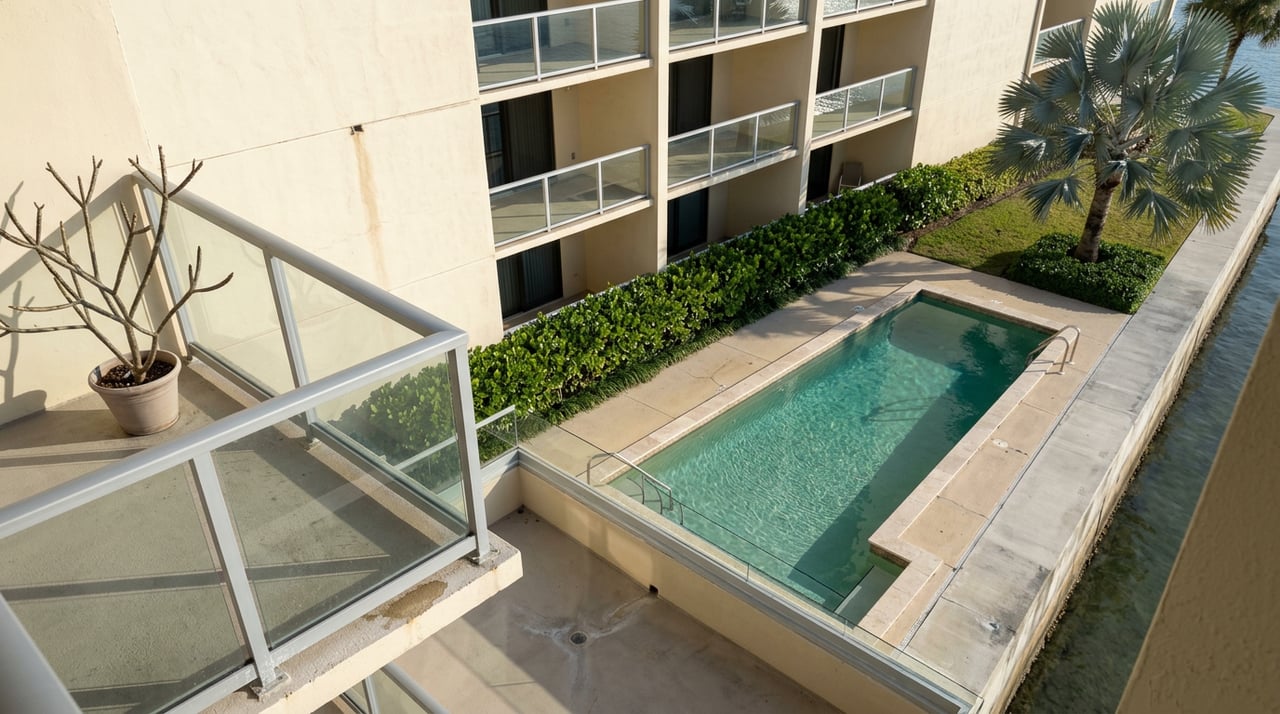
A listing on Gulf Boulevard advertises something that would have been an afterthought five years ago: all assessments paid, milestone inspection and engineering report completed, new roof installed in 2024. The unit also happens to have a freshly poured seawall going in around the property and re-landscaped grounds with mature palms. None of that is about the kitchen or the view. It is about paperwork, and in 2026 that paperwork is doing more to set the price than the square footage.
A few buildings down, another unit in a comparable structure sits at a similar price per square foot, with no such language on the listing sheet. Same era of construction. Same stretch of sand. On paper, they look like the same purchase. They are not, and the difference has nothing to do with finishes.
The Median Price Is Blending Two Different Markets
St. Pete Beach's headline numbers read soft right now. Over the three months ending May 2026, home prices across the city were down 5.5 percent compared to the same period a year earlier, with a median sale price of $605,000. The average single-family house price, measured over the most recent month reported, came in at $543,000, down 22.5 percent year over year. Homes are also sitting longer: an average of 83 days on market, up from 45 days a year ago.
Those numbers get repeated as if they describe one market. They do not. Single-family inventory across the broader Tampa Bay region is running at roughly 3 to 4 months of supply, which is still tight by historical standards. Condo inventory specifically in Pinellas County has pushed past 8 months, which is squarely buyer's market territory. St. Pete Beach is almost entirely a condo and townhome market along its Gulf-facing stretch, so when the citywide median softens, it is disproportionately the condo side doing the softening.
That still doesn't explain why. A price drop tells you sentiment shifted. It does not tell you whether a specific unit is a genuine value or a building quietly working through a structural bill that hasn't been assessed yet.
Why the Coastline Sets an Earlier Deadline
Florida's post-Surfside building safety law, Florida Statute 553.899, requires condominium and cooperative buildings three stories or taller to complete a Phase 1 milestone inspection once the building reaches a set age, then again every 10 years. For most of the state, that trigger is 30 years. For any building within 3 miles of the coastline, it drops to 25 years.
Every multi-story condo on St. Pete Beach sits on a barrier island directly against the Gulf. There is no version of "3 miles from the coast" that excludes anything here. That means the classic Gulf Boulevard buildings from the 1960s through the 1980s hit their first mandatory structural inspection five years earlier than a similarly aged building sitting inland in, say, downtown St. Petersburg. A lot of that inspection wave has already happened. Buildings that reached 30 years of age before July 2022 had to complete their initial milestone inspection by the end of 2024, and the coastal 25-year clock has been running the whole time alongside it.
Layered on top of the inspection requirement is the Structural Integrity Reserve Study, or SIRS, which determines how much an association needs to be setting aside for major structural components: roofs, load-bearing walls, waterproofing, electrical systems. As of January 1, 2026, full funding of those reserve line items is mandatory and associations can no longer vote to waive or reduce the contribution, a practice many buildings used for decades to keep monthly dues artificially low. That's the bill coming due now, all at once, in buildings that deferred it.
What "All Assessments Paid" Is Actually Advertising
This is why the listing language matters. A building that has already completed its milestone inspection, funded its SIRS, and cleared any related special assessment is telling a buyer something specific: the structural bill for this building has already been paid by someone else. A building that hasn't gotten there yet is carrying that bill forward, and it lands on whoever owns the unit when the board finally votes.
The range on those assessments is wide and not small. Reports across Florida buildings have run from a few thousand dollars to well over $100,000 per unit for major structural work, and even structurally sound buildings are seeing mid-year assessments driven purely by insurance premium increases. HOA fees across the Tampa-St. Petersburg metro rose 17.2 percent year over year earlier in 2026, the steepest increase of any major metro tracked, which gives some sense of how widespread the catch-up costs have become even in buildings that never fail an inspection.
Here's what that split looks like in practical terms for two otherwise comparable St. Pete Beach units:
| Building has cleared SIRS and milestone | Building is still catching up | |
|---|---|---|
| Special assessment exposure | Already resolved, priced into current dues | Could arrive at any board meeting, $10K to $100K+ per unit reported statewide |
| HOA due trajectory | Larger up front, more predictable going forward | Lower now, likely to jump sharply once the SIRS number is final |
| Lender treatment | Easier to finance | Risk of falling "non-warrantable," affecting rate and down payment |
| What the list price reflects | The building's real, current cost of ownership | A price that may not yet include the bill that's coming |
Neither column is automatically the better buy. A building still working through the process might be priced to reflect exactly that risk, and a savvy buyer with cash reserves might come out ahead. But you can only make that call if you know which column you're looking at, and the list price alone won't tell you.
The Financing Twist Nobody Mentions at the Open House
There's a second layer that catches buyers off guard even when they've done their homework on the assessment itself. Fannie Mae updated its condo project review standards in early 2026, and buildings can now be flagged non-warrantable for reasons directly tied to this compliance wave: a failed or incomplete milestone inspection, non-compliance with SIRS requirements, a reserve fund below minimum thresholds, inadequate master insurance coverage, or a pending special assessment significant enough to affect the building's overall financial health.
If a building loses its warrantable status, the loan terms available to a buyer can change meaningfully, sometimes surfacing after the buyer is already under contract and the lender runs its project review. That's a hard place to discover a problem, and it's a reason to push that verification earlier in the process rather than later.
Questions to Ask Before You Write the Offer
A few requests, made before an offer goes in rather than after, cover most of this ground:
- Ask the association directly for the current SIRS and the percent-funded figure, not just whether one exists. A completed study that's only 40 percent funded is a very different situation than one that's fully funded.
- Confirm the milestone inspection phase. Phase 1 is largely visual. If Phase 2 was triggered, ask what it found and whether repairs have started.
- If the building has 25 or more units, its governing documents, budget, and reserve study should already be posted to an association website or app under a 2024 transparency law. If they're not posted, that's worth asking about directly.
- Check the building's rental policy separately from the financial documents. Requirements vary building to building along the same stretch of Gulf Boulevard: some associations, like the one governing the San Seair, require a minimum six-month lease, while others permit shorter terms. It has nothing to do with structural compliance, but it affects what the unit can do for you as an owner.
- If anything is unresolved, ask your lender to run a preliminary condo project review before you're deep into a contract, not after.
The city's building department can also confirm whether a milestone report has actually been filed for a given address, which is worth doing independently of whatever the seller's side represents.
A Few Common Questions
Does any of this apply to single-family homes on St. Pete Beach? No. The milestone inspection and SIRS requirements apply to condominium associations under Florida Statute Chapter 718, specifically buildings three stories or taller. Single-family homes fall under a different chapter and aren't subject to these particular rules.
If a building has already cleared everything, does that mean it's not a good deal? Not necessarily. It means the price reflects a known, resolved cost rather than an unresolved one. Some of the strongest values on the beach right now are buildings that did the work early and are pricing accordingly, without a structural surprise waiting in the wings.
Is this only a St. Pete Beach issue? The law is statewide, but the 3-mile coastal trigger means it hits barrier island communities like this one on a faster clock than it hits inland buildings, which is part of why this particular market is worth looking at closely right now.
The softening you're seeing in St. Pete Beach's numbers this year is real, but it's not one story. It's two buildings' worth of stories layered into a single median. Figuring out which one you're buying into is the actual due diligence, and it's worth doing before the price on the sign becomes the price you're actually paying.
If you're comparing specific buildings on St. Pete Beach and want a straight read on where a property stands before you write an offer, Michael Tadros at Shore2Bay Realty can walk through the documents with you and help you get your instant home valuation on what you already own or are considering.